Ink Daisy Watercolor Seamless Border: A Strategic Asset for Professional Design Workflows
In the landscape of modern graphic design, the difference between a good project and a memorable brand identity often lies in the selection of high-quality foundational assets. The Ink Daisy Watercolor Seamless Border represents more than just a decorative image; it is a functional tool designed to streamline the creative process while elevating the visual output of commercial projects. This specific asset, delivered as a single PNG file with a resolution of 5000 pixels on the longest side and a density of 300 DPI, addresses the critical need for crisp, scalable graphics that maintain integrity across various media formats. For professionals ranging from boutique packaging designers to wedding stationery artists, integrating this botanical illustration into a workflow requires an understanding of its technical specifications, aesthetic versatility, and practical application scenarios.
Technical Specifications and Workflow Preparation
Before implementing any digital asset, a designer must evaluate its compatibility with their intended output medium. The Ink Daisy Watercolor Seamless Border is engineered for high-fidelity reproduction. The 300 DPI (dots per inch) standard is the industry benchmark for print production, ensuring that when the file is scaled down or printed at full size, the soft white pigments and precise ink detailing remain sharp without pixelation. The 5000-pixel dimension on the longest side provides substantial canvas real estate, allowing for large-scale applications such as banners, backdrops, or wide-format packaging wraps without the need for upscaling algorithms that degrade image quality.
From a preparation standpoint, the PNG format offers distinct advantages over JPEGs regarding transparency. In a professional workflow, this means the border can be layered directly over textured paper backgrounds, colored stock, or complex product photography without requiring time-consuming masking or background removal processes. When organizing a project folder, this asset should be categorized under "High-Res Borders" or "Print-Ready Elements." Ensuring the file is color-managed correctly—typically in CMYK for final print outputs or RGB for digital screens—is a crucial step before importing it into design software like Adobe Illustrator, Photoshop, or Canva. By verifying these technical parameters early in the planning phase, creators avoid the common pitfall of discovering resolution issues during the final proofing stage, which can delay project timelines and increase costs.
Aesthetic Integration and Brand Consistency
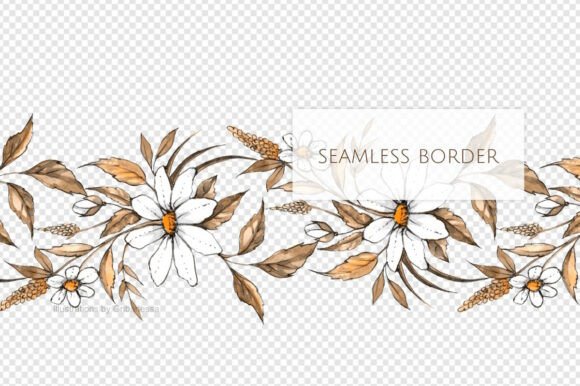
The visual language of the Ink Daisy Watercolor Seamless Border combines organic fluidity with structural precision. The artistic meadow daisies are rendered using soft white pigments contrasted against warm earthy tones, creating a sophisticated palette that bridges the gap between rustic charm and modern minimalism. This specific color profile makes the asset highly adaptable for branding strategies that aim to convey trust, natural quality, and artisanal care. Whether the goal is to launch a new line of organic skincare products or to design a seasonal interior decor catalog, the border serves as a unifying element that ties disparate components together.
Consistency is a cornerstone of effective branding. Using a seamless horizontal repeat allows designers to create continuous patterns that wrap around cylindrical containers, frame website headers, or define the edges of business cards. Unlike static clip art, which can appear disjointed when repeated, the seamless nature of this border ensures a fluid transition where the pattern meets itself. This continuity is essential for textile trims and wallpaper designs, where visible seams can break the illusion of a handcrafted finish. By adopting this asset, brands can maintain a cohesive visual identity across touchpoints, reinforcing the perception of a polished, professional operation. The precise ink detailing adds a layer of refinement that distinguishes the work from generic stock imagery, signaling to the consumer that attention to detail is a priority.
Practical Use Cases Across Industries
The versatility of the Ink Daisy Watercolor Seamless Border extends across multiple sectors, each with unique requirements for implementation. In the realm of wedding stationery, this asset is particularly valuable for creating suites that include invitations, menus, and place cards. The floral motif evokes a sense of celebration and romance, while the watercolor texture suggests a bespoke, hand-painted quality that couples often seek. Designers can apply the border as a subtle frame or use it as a dominant feature to separate text blocks, enhancing readability while adding elegance.
For product packaging, especially in the food and beverage or cosmetics industries, the border acts as a premium indicator. High-end product labels often rely on intricate details to justify price points and communicate quality. The earthy tones of the daisy illustration pair exceptionally well with kraft paper, matte finishes, and embossed textures. During the prototyping phase, designers can test how the border interacts with different material samples to ensure the final result aligns with the brand's tactile goals. The high resolution ensures that even on small label surfaces, the ink lines remain distinct, preventing the muddy appearance that often plagues low-resolution assets when printed at scale.
In digital marketing and web design, the asset serves as an effective header or footer element. Websites for boutiques, florists, and lifestyle blogs can utilize the seamless repeat to create dynamic scrolling backgrounds or section dividers. Because the file is a PNG, it integrates seamlessly into HTML/CSS layouts or content management systems without heavy loading times, provided the dimensions are optimized for screen display. This dual capability—excelling in both print and digital environments—makes the asset a cost-effective investment for businesses looking to unify their omnichannel presence.
Implementation Strategies and Tool Compatibility
Integrating the Ink Daisy Watercolor Seamless Border into a design project involves strategic decision-making regarding placement and scaling. When working within vector-based software like Adobe Illustrator, users can import the raster PNG and utilize it as a reference or mask. However, for maximum flexibility, it is often beneficial to trace key elements if custom color adjustments are required, though the original watercolor texture is best preserved by keeping the raster file intact. In raster environments like Photoshop, the seamless tile function allows for quick generation of larger pattern swatches, enabling designers to preview how the border looks when extended indefinitely.
Efficiency in the creative process is enhanced by the asset's ready-to-use nature. There is no need for extensive editing or cleanup, which frees up time for higher-level tasks such as typography selection, layout composition, and client communication. For freelancers and small business owners managing multiple projects simultaneously, having a library of reliable, high-quality borders reduces the cognitive load associated with sourcing new graphics for every assignment. It allows for rapid iteration during the concept phase, enabling stakeholders to visualize the final product quickly.
Furthermore, the asset interacts well with other design resources. It complements serif fonts, handwritten scripts, and minimalist geometric shapes, offering a balance between organic and structured design elements. When paired with complementary colors such as sage green, terracotta, or charcoal gray, the warm earthy tones of the daisies become even more pronounced. Designers should consider the hierarchy of information when placing the border; it should enhance the primary content rather than compete with it. Using opacity adjustments or blending modes can further refine the integration, allowing the border to recede slightly into the background or pop forward depending on the desired emphasis.
Long-Term Value and Quality Control
Investing in high-resolution assets like the Ink Daisy Watercolor Seamless Border yields long-term value through reusability and adaptability. As a brand evolves, core visual elements often remain consistent to maintain recognition. This border can be archived and reused for future campaigns, seasonal updates, or derivative products, ensuring a consistent aesthetic history. The 300 DPI quality ensures that the asset remains viable for years, even as printing technologies advance and demand for higher fidelity increases.
Quality control is another significant benefit. By using a professionally created asset, designers mitigate the risk of copyright infringement and legal complications associated with unlicensed stock images. The clear licensing terms typically associated with such specific files provide peace of mind for commercial projects. Additionally, the consistency of the artwork helps in maintaining brand standards across different vendors and printers. When sending files to third-party manufacturers, the high resolution and transparent background reduce the likelihood of misinterpretation or poor reproduction, leading to a smoother production workflow and fewer revisions.
Ultimately, the Ink Daisy Watercolor Seamless Border is a strategic component in the toolkit of any serious creator. It supports a workflow that prioritizes efficiency, quality, and aesthetic coherence. From the initial planning stages to the final execution, this asset facilitates the creation of sophisticated designs that resonate with target audiences. By understanding its technical capabilities and applying it with intention, professionals can elevate their portfolios and deliver exceptional results that stand out in a competitive marketplace.